

Estimate Review for General Contracting
Estimate Review defines how a completed estimate is checked, challenged, and refined before it is used for risk assessment and bid submission. It brings fresh eyes from estimating, operations, and leadership to validate scope coverage, costs, phasing, general conditions, and commercial assumptions. The process uses structured checklists, comparison data, and review meetings instead of casual “quick looks.” When followed, the number you carry represents a deliberate decision, not just what happened to be in the spreadsheet at the deadline.
Prepare Estimate Review Checklist and Agenda
Step 1: Locate standard estimate review checklist
Find your company’s standard estimate review checklist, if one exists. If there is no formal checklist, gather any informal lists or prior review notes that can serve as a starting point. Save a copy in the bid folder so you are not editing the original template.
Step 2: Customize checklist for this project
Review the estimate size, complexity, sector, and any unusual elements (for example, heavy phasing, unusual systems, tight site). Add checklist items specific to these issues, such as “verify after-hours premiums” or “double-check specialty equipment quotes.” Remove sections that clearly do not apply to avoid wasting review time.
Step 3: Define review sections and order
Group checklist items into logical sections such as “Scope and Quantities,” “Subcontractor/Vendor Pricing,” “Self-Perform,” “General Conditions,” “Commercial (Fee/Bond/Insurance),” and “Alternates/Allowances.” Decide the order in which they will be discussed so the meeting flows from big-picture to details.
Step 4: Draft a simple agenda with time estimates
For each section, estimate how much time you will allocate in the review meeting. For example, 15 minutes for overall summary, 20 minutes for major trades, 15 minutes for general conditions, etc. This helps keep the meeting moving and signals where you expect the most discussion.
Step 5: Identify required attendees and their roles
List who needs to attend (lead estimator, assisting estimators, operations rep, project executive, possibly purchasing). Next to each name, note their role in the review (for example, “challenge general conditions,” “sanity-check MEP”).
Step 6: Save agenda and checklist in bid folder and share
Save the customized checklist and agenda in the bid folder with clear names. Email or message the review group with the documents attached or linked so they can prepare before the meeting.
Perform Pre-Review Self-Check of Estimate
Step 1: Run system audit and math checks
Use your estimating software’s built-in audit tools to check for broken formulas, negative quantities, or items with zero cost. Review any warnings the system flags and correct obvious errors on the spot.
Step 2: Scan for empty or placeholder cost lines
Look through each division or summary report for items that have quantities but no cost, or that are clearly labeled as placeholders (for example, “TBD” or “future scope”). Either fill in realistic costs, mark them as deliberate zeros with notes, or remove unused placeholders.
Step 3: Verify major totals against takeoff and benchmarks
Compare total concrete, steel, drywall, and MEP costs against internal unit cost benchmarks (for example, cost per SF or cost per CY). Investigate any categories that are significantly out of line with similar projects you know.
Step 4: Check that alternates and allowances are clearly separated
Confirm that alternates are not unintentionally mixed in with base scope and that allowances are clearly labeled as such. If necessary, move costs into proper alternate/allowance sections and update descriptions.
Step 5: Ensure descriptions and notes are understandable
Read through key cost items and their notes as if you were a reviewer seeing them for the first time. Expand vague descriptions such as “misc. work” into something more specific, and replace shorthand or internal codes with clear language.
Step 6: Save a “Pre-Review” version of the estimate
Once you have cleaned up obvious issues, save the estimate under a new version name like “Estimate_PreReview_Date.” This marks the snapshot that will be used in the formal review, and you can always roll back if needed.
Review Scope Completeness by Division and Trade
Step 1: Print or open division and trade summaries
Run reports that summarize costs by CSI division and by trade or bid package. Have these summaries visible alongside your project plans, specs, and bid package matrix.
Step 2: Walk through each division against drawings and specs
For each division, ask, “What are the major components here?” and confirm that each appears as a line or group in the estimate. For example, in Division 03 (Concrete), you should see foundations, slabs, toppings, and any special elements.
Step 3: Check against bid package matrix and responsibility boundaries
Compare the estimate to your subcontractor bid package matrix. Make sure that scopes assigned to subs are actually represented in subcontractor cost lines and that self-perform scopes are present where expected.
Step 4: Look for missing or double-counted items
Flag any work that appears in drawings and specs but not in the estimate. Also look for obvious overlap, such as site concrete counted separately in both civil and architectural sections. Make a note of potential omissions or double counts.
Step 5: Capture scope issues in a review notes list
As you find concerns, write them into a simple “Scope Review Notes” document with division, description, and whether it might be a gap or overlap. You will address these items in more detail during and after the review meeting.
Step 6: Share scope review notes with review team
Attach or link the scope review notes when you send out the review package so other reviewers see what you have already noticed and can add to the list.
Review General Conditions and Staffing Assumptions
Step 1: Open general conditions detail report
Run a detailed report for all general condition cost codes, including staff, trailers, temporary facilities, safety, and cleanup. Have the project schedule or duration assumptions handy for reference.
Step 2: Check staff roles, durations, and overlaps
For each staff position (project manager, superintendent, project engineer, etc.), confirm that the duration matches the planned project length and phasing. Look for positions that seem to overlap unnecessarily or are clearly under- or over-staffed.
Step 3: Review temporary facilities and site services vs logistics
Compare line items like trailers, toilets, fencing, temporary power, and security to your logistics notes and site conditions. Ask whether each item is truly needed, and whether durations and quantities make sense.
Step 4: Validate safety and quality-related costs
Confirm that safety-related items (PPE, safety supplies, safety meetings) and quality items (mockups, extra inspections) are included at a reasonable level. These should reflect company standards and any project-specific requirements.
Step 5: Benchmark general conditions against similar projects
Calculate general conditions as a percentage of total direct costs or cost per month of project duration. Compare these metrics to similar past projects and note large deviations for discussion.
Step 6: Document questions and proposed adjustments
Make a short list of potential adjustments, such as changing staff durations or adding/removing certain temporary facilities. Bring this list into the review meeting for group discussion rather than making unilateral changes.
Review Risk, Contingencies, and Allowances
Step 1: List all explicit contingencies and allowances
Run a report or filter in your estimate to show all cost lines tagged as contingency or allowance. Copy these into a small summary table with descriptions and dollar amounts.
Step 2: Compare contingencies to identified risks
Review your risk register, assumptions log, and RFI responses. Ask whether the contingency amounts reasonably cover the risks you have actually identified (for example, unknown underground conditions, incomplete design, occupied work).
Step 3: Check for “hidden contingency” in unit rates
Scan major unit prices for signs of extra padding that is not labeled as contingency. Examples include unusually high crew costs, unusually high waste factors, or duplication of risk coverage in multiple places.
Step 4: Verify that allowances are labeled and described
Ensure every allowance is clearly labeled as such and has a short description of what is expected to be purchased under that allowance. This will matter for both client communications and internal tracking if you win.
Step 5: Align contingency level with company guidelines
Compare your total contingency as a percentage of cost to company guidelines for projects of this type and risk level. If you are above or below typical ranges, be prepared to explain why.
Step 6: Record proposed changes and rationale
Document any suggested adjustments to contingency or allowances, along with the reasoning (for example, “reduced design risk contingency after Addendum 3 resolved major unknowns”). These notes will support decisions made in the review meeting.
Review Fee, Overhead, Bond, and Insurance Assumptions
Step 1: Open summary of fee and commercial adders
Run a report that shows project fee, general overhead, bonds, and insurance as separate line items along with their base (what they are applied to). Check that the math is working correctly in the software.
Step 2: Check fee percentage vs target and market
Compare the fee percentage used in the estimate to internal target ranges and what you know about the market for this client and project type. Note whether you are above, below, or at the expected level.
Step 3: Confirm bond and insurance requirements from documents
Review bid instructions and draft contract documents for required bond types and limits and any special insurance (for example, builders risk, pollution liability). Make sure your estimate includes all required coverages.
Step 4: Verify bond and insurance rates
Check that the rates applied for bonds and special insurance match current quotes or internal rate sheets. Update rates if there have been recent changes or if the project size moves you into a different bracket.
Step 5: Assess whether risk profile justifies adjustments
Discuss whether unusual project risk (for example, very tight schedule, difficult client, complex phasing) suggests that fee or contingency should be adjusted up or that you can afford to be more aggressive.
Step 6: Note any required leadership decisions
If the review suggests changing fee, overhead, or commercial assumptions, summarize these options and flag them as decisions needed from leadership during or after the review meeting.
Compare Estimate to Benchmarks and Prior Phases
Step 1: Gather prior budgets and reference projects
Collect any earlier budgets for this project (conceptual, schematic, design development) and a small set of similar past projects with known final costs. Make sure you note the basis and date of each.
Step 2: Generate high-level cost summaries and unit costs
Run estimate summaries by major building systems (structure, envelope, interiors, MEP, general conditions) and calculate basic unit costs such as total cost per SF and system costs per SF where meaningful.
Step 3: Compare current estimate to earlier budgets
Line up earlier budgets with the current estimate by major category and note where costs have moved significantly up or down. Pay attention to whether changes are due to scope, design evolution, or pricing.
Step 4: Compare to similar completed projects
For each referenced past project, compare key metrics: size, type, complexity, and cost per SF. Identify where your current estimate is unusually high or low relative to those jobs.
Step 5: Identify categories requiring deeper explanation
Make a list of divisions or systems where your estimate differs significantly from both earlier budgets and comparison projects. These are areas you will need to explain in review meetings and potentially adjust.
Step 6: Document findings in a short comparison memo
Write a simple memo or spreadsheet that summarizes major comparisons and your initial explanations. Save it in the bid folder and include it in the review package sent to stakeholders.
Conduct Formal Estimate Review Meeting
Step 1: Schedule the review with required participants
Send a calendar invite to the review team (estimating, operations, leadership, purchasing as needed) with enough lead time before the bid deadline. Attach the agenda, checklist, executive summary, and key reports.
Step 2: Set up the room or virtual meeting with visuals
Ensure you can display the estimate summary, comparison data, and key reports on a screen or shared screen. Have printed copies of the executive summary and assumptions for those who prefer paper.
Step 3: Walk through the high-level summary first
Start the meeting with total cost, cost per SF, major system breakdowns, fee, and contingency. This gives everyone a sense of the overall position before diving into details.
Step 4: Review each checklist section and discuss issues
Work through your review checklist section by section (scope, general conditions, risk, commercial, etc.), highlighting the issues you identified during pre-review. Invite questions and challenges from attendees.
Step 5: Capture decisions, action items, and owners
As the group agrees on changes or confirms certain assumptions, record each decision in a simple action log with a description, responsible person, and due date. Note items that require further outside information.
Step 6: Confirm next steps and review outcomes
At the end of the meeting, restate the main outcomes: whether the overall number is directionally acceptable, what changes will be made, and any open questions that must be resolved prior to bid risk assessment or submission.
Implement Review Changes and Update Estimate
Step 1: Organize review action items by type
Open your review action log and group tasks into categories: scope corrections, pricing changes, general conditions adjustments, contingency/fee updates, and documentation/notes updates.
Step 2: Work through scope and cost adjustments first
Starting with scope and direct cost items, adjust quantities, add or remove line items, and update subcontractor or vendor selections as agreed in the meeting. Keep notes explaining each significant change.
Step 3: Update general conditions, contingency, and fee
Apply agreed changes to staff durations, temporary facilities, contingencies, and fee percentages. Re-run summaries to see the combined effect of these changes on the total cost.
Step 4: Refresh comparison and benchmark checks
After major changes, re-run key summaries and, if necessary, quick comparisons to prior budgets or benchmarks to ensure the estimate still makes sense in context.
Step 5: Update assumptions, clarifications, and exclusions
Revise the written assumptions and exclusions list to reflect the current estimate, especially if scope, contingency, or commercial terms have changed. Remove outdated notes that no longer apply.
Step 6: Save “Post-Review” estimate version and document changes
Save the updated estimate under a new name such as “Estimate_PostReview_Date.” Attach or link a brief change log summarizing the key modifications from the pre-review version so others can see what changed.
Finalize Estimate Review Summary for Leadership
Step 1: Update executive summary with final numbers
Revise the executive summary sheet to reflect the post-review estimate total, cost per SF, major system breakdowns, fee, contingency, and general conditions totals. Double-check that all figures match the current estimate reports.
Step 2: Highlight significant changes made during review
Add a short section that outlines major changes from the pre-review version, such as “increased general conditions due to longer schedule” or “reduced structural contingency after updated vendor quotes.” This helps leadership quickly see what shifted.
Step 3: Summarize top risks and how they are covered
List the most important risks identified (for example, design completeness, site constraints, MEP complexity) and state whether they are covered by contingency, specific line items, or assumptions that need client clarification.
Step 4: Attach or link supporting reports
Include or link the main estimate reports, subcontractor and vendor comparison summaries, and the assumptions and exclusions document. Make sure file names are clear and consistent.
Step 5: Note open questions and required decisions
Create a brief list of any items that still require decisions from leadership (for example, “accept lower fee to stay competitive” or “approve higher contingency for unknown abatement”).
Step 6: Save and share the review summary
Save the finalized summary in the bid folder and send it to leadership and other key stakeholders with a short email explaining that the Estimate Review stage is complete and the estimate is ready for Bid Risk Assessment.
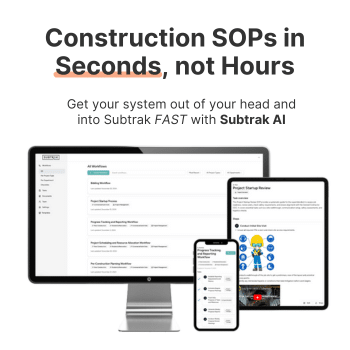
👈 Use this SOP template inside Subtrak
Edit with AI. Customize in seconds. Store and share all your SOPs and checklists in one place.