
Concept Estimate Preparation Checklist for Home Builder
This checklist is designed to guide a home builder specializing in custom homes through the process of preparing a concept estimate. The checklist ensures that all necessary steps are taken to develop an accurate and realistic estimate for new construction projects. It includes reviewing preliminary design materials, leveraging historical cost data, identifying missing information, applying allowances, and calculating a realistic estimate range. The process also emphasizes quality checks, documentation, and internal review to ensure precision and completeness.
Review preliminary design materials
Step 1: Gather design documents
Collect all available design documents, including sketches, floor plans, and any other relevant materials. Ensure that you have the most current versions to avoid discrepancies.
Step 2: Assess design completeness
Evaluate the completeness of the design documents. Note any areas that are unclear or lacking detail, as these will need further clarification before proceeding.
Step 3: Identify key design elements
Identify and list key design elements that will significantly impact the cost, such as custom features, materials, and finishes. This will help in focusing on critical cost drivers.
Use historical cost data
Step 1: Access historical project records
Retrieve records from past projects that are similar in scope and scale. Ensure the data is relevant and up-to-date to provide an accurate basis for comparison.
Step 2: Analyze cost trends
Examine trends in material and labor costs over time. Identify any patterns or anomalies that could affect the current estimate.
Step 3: Adjust for project specifics
Modify historical data to reflect the specific conditions and requirements of the current project, such as location, design complexity, and market conditions.
Identify missing information
Step 1: List missing details
Create a list of missing or unclear details in the design documents. This may include specific material selections, dimensions, or construction methods.
Step 2: Communicate with stakeholders
Reach out to the client, architect, or other relevant parties to obtain the missing information. Ensure clear communication to avoid misunderstandings.
Step 3: Document responses
Record all responses and updates received. Maintain a clear and organized record to reference throughout the estimating process.
Apply allowances
Step 1: Determine allowance categories
Identify categories where allowances are necessary, such as fixtures, finishes, or landscaping. These are typically areas with high variability.
Step 2: Set realistic allowance values
Based on historical data and current market conditions, set realistic allowance values that reflect potential costs. Ensure these are communicated to the client.
Step 3: Review and adjust allowances
Periodically review and adjust allowances as more information becomes available. This helps in maintaining an accurate estimate throughout the project lifecycle.
Review site conditions
Step 1: Conduct site visit
Perform a site visit to assess the physical conditions, including topography, access, and existing structures. Take detailed notes and photographs for reference.
Step 2: Identify regulatory requirements
Research local zoning laws, building codes, and environmental regulations that may impact the project. Ensure compliance to avoid delays and additional costs.
Step 3: Assess logistical challenges
Evaluate potential logistical challenges, such as transportation access, utility connections, and site security. Plan for these in the estimate.
Calculate realistic concept estimate range
Step 1: Compile cost components
Gather all cost components, including materials, labor, equipment, and subcontractor fees. Ensure all elements are accounted for in the estimate.
Step 2: Incorporate contingencies
Include a contingency allowance to cover unforeseen expenses. This is typically a percentage of the total estimate and varies based on project complexity.
Step 3: Establish estimate range
Calculate a low and high estimate range based on the compiled data. This range provides a realistic expectation of potential costs.
Perform quality checks
Step 1: Verify calculations
Double-check all calculations for accuracy. Use software tools or manual methods to ensure there are no errors in the math.
Step 2: Cross-reference with historical data
Compare the estimate with historical data to identify any discrepancies. This helps in validating the assumptions and figures used.
Step 3: Review by a senior estimator
Have a senior estimator or manager review the estimate. Their experience can provide valuable insights and catch potential oversights.
Document and present estimate
Step 1: Compile estimate report
Create a comprehensive estimate report that includes all relevant details, assumptions, and calculations. Ensure it is well-organized and easy to understand.
Step 2: Include supporting documentation
Attach any supporting documents, such as design drawings, site assessments, and correspondence with stakeholders. This provides context and justification for the estimate.
Step 3: Present to stakeholders
Present the estimate to the client and other stakeholders. Clearly explain the basis of the estimate and be prepared to answer questions or provide clarifications.
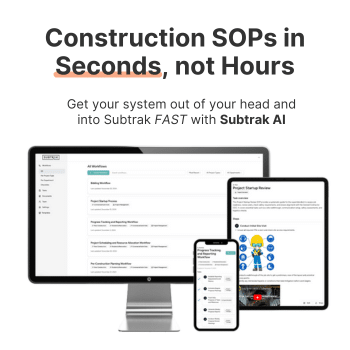
👈 Use this SOP template inside Subtrak
Edit with AI. Customize in seconds. Store and share all your SOPs and checklists in one place.