
Project Startup Checklist for Home Builder
This checklist outlines the essential steps for initiating a new custom home construction project. It ensures that all pre-construction activities are thoroughly completed, setting a solid foundation for the project’s success. The checklist covers reviewing contract documents, confirming scope and allowances, verifying site conditions, checking design completeness, preparing initial risk assessments, setting up communication channels, and establishing required documentation. It also emphasizes internal coordination between sales, estimating, project management, and trade partners to ensure a smooth transition into active planning.
Review contract documents
Step 1: Gather all contract documents
Collect all relevant contract documents, including the signed agreement, addendums, and any referenced specifications or standards. Ensure that you have the most current versions of each document.
Step 2: Verify contract terms and conditions
Carefully read through the contract terms and conditions. Pay attention to payment schedules, timelines, penalties, and any special clauses that may affect the project execution.
Step 3: Identify potential discrepancies
Look for any inconsistencies or unclear language within the contract. Note any areas that require clarification or further discussion with the client or legal team.
Step 4: Confirm contract compliance
Ensure that the contract complies with local building codes and regulations. Consult with legal counsel if necessary to verify compliance.
Confirm scope and allowances
Step 1: Review project scope
Examine the project scope document to ensure all deliverables, milestones, and responsibilities are clearly outlined. Confirm that the scope aligns with the client's expectations and contract terms.
Step 2: Verify allowances
Check the allowances specified in the contract for materials and finishes. Ensure they are realistic and sufficient for the project's requirements.
Step 3: Discuss scope with stakeholders
Hold a meeting with key stakeholders, including the client, sales team, and project manager, to confirm the scope and allowances. Address any concerns or discrepancies identified during the review.
Verify site conditions
Step 1: Conduct a site visit
Visit the construction site to assess its current condition. Look for any obstacles, such as existing structures, vegetation, or utilities, that may need to be addressed before construction begins.
Step 2: Evaluate site access
Check the accessibility of the site for construction vehicles and equipment. Ensure there are clear paths for delivery and movement of materials.
Step 3: Document site conditions
Take photographs and notes of the site conditions. Document any potential issues or hazards that need to be addressed before construction starts.
Step 4: Coordinate with surveyor
Arrange for a professional surveyor to verify property boundaries and topographical features. Ensure that the survey aligns with the project plans.
Check design completeness
Step 1: Review architectural plans
Examine the architectural drawings to ensure they are complete and detailed. Verify that all necessary elevations, sections, and details are included.
Step 2: Verify engineering plans
Check the structural, mechanical, electrical, and plumbing plans for completeness. Ensure that all engineering calculations and specifications are included.
Step 3: Confirm design approvals
Ensure that all design documents have been reviewed and approved by the necessary authorities, such as local building departments or design review boards.
Step 4: Coordinate with design team
Meet with the design team to discuss any outstanding issues or questions. Confirm that all design elements are aligned with the project scope and client expectations.
Prepare initial risk assessments
Step 1: Identify potential risks
List potential risks related to the project, such as weather delays, material shortages, or safety hazards. Consider both internal and external factors that could affect the project.
Step 2: Evaluate risk impact
Assess the potential impact of each identified risk on the project's timeline, budget, and safety. Determine the likelihood of each risk occurring.
Step 3: Develop risk mitigation strategies
Create strategies to mitigate each identified risk. This may include contingency plans, alternative suppliers, or additional safety measures.
Step 4: Document risk assessment
Compile the risk assessment findings into a report. Share the report with the project team and stakeholders to ensure everyone is aware of potential risks and mitigation strategies.
Set up communication channels
Step 1: Identify communication needs
Determine the communication needs of the project, including the frequency and format of updates, meetings, and reports. Consider the preferences of key stakeholders.
Step 2: Select communication tools
Choose appropriate communication tools, such as email, project management software, or video conferencing platforms, to facilitate effective communication.
Step 3: Establish communication protocols
Define protocols for communication, including who is responsible for sending updates, how often updates will be sent, and how issues will be escalated.
Step 4: Communicate protocols to team
Share the established communication protocols with the project team and stakeholders. Ensure everyone understands their roles and responsibilities in maintaining effective communication.
Establish required documentation
Step 1: Identify required documents
List all documents required for the project, such as permits, insurance certificates, and subcontractor agreements. Ensure that all necessary documents are accounted for.
Step 2: Create document templates
Develop templates for recurring documents, such as meeting minutes or progress reports, to ensure consistency and efficiency in documentation.
Step 3: Set up document management system
Establish a system for organizing and storing project documents, such as a cloud-based document management platform. Ensure that the system is accessible to all relevant team members.
Step 4: Train team on documentation procedures
Provide training to the project team on how to use the document management system and follow documentation procedures. Ensure everyone understands the importance of accurate and timely documentation.
Coordinate internal team transition
Step 1: Schedule transition meeting
Organize a meeting with all internal teams, including sales, estimating, project management, and key trade partners. Set a clear agenda to discuss the project handover.
Step 2: Review project details
During the meeting, review all project details, including scope, budget, timelines, and key deliverables. Ensure that all teams have a clear understanding of the project's objectives.
Step 3: Assign roles and responsibilities
Clearly define the roles and responsibilities of each team member and trade partner. Ensure everyone knows their tasks and how they contribute to the project's success.
Step 4: Establish coordination protocols
Set protocols for ongoing coordination between teams, including regular check-ins and updates. Ensure that everyone knows how to communicate effectively and escalate issues if necessary.
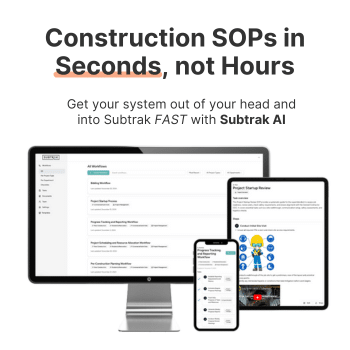
👈 Use this SOP template inside Subtrak
Edit with AI. Customize in seconds. Store and share all your SOPs and checklists in one place.