

Post-Project Review for Home Builder
Post-Project Review is the formal evaluation of a completed home against targets for budget, schedule, quality, and client satisfaction. The process combines data, field feedback, trade input, and client comments into a structured review. Key issues, patterns, and successes are translated into specific changes to estimating, standards, details, and procedures. Regular post-project reviews create a feedback loop that steadily improves performance across future builds.
Collect project financial performance data against budget
Step 1: Pull final job cost and billing reports
Work with accounting to generate final job cost reports, billing summaries, and margin reports for the project. Confirm that all invoices, change orders, and credits have been posted so the data reflects true final numbers. Save these reports in a dedicated Post-Project Review folder for this job.
Step 2: Obtain original and current budget data
Export the original approved budget and the latest revised budget if it was updated during the job. Ensure budget and cost reports use the same cost code structure so they can be compared easily. Note any structural changes to codes that occurred mid-project.
Step 3: Summarize cost and margin by major category
Group costs and budget by major buckets such as sitework, structure, MEP, interiors, finishes, and overhead. Calculate variances for each bucket in dollars and percentage versus budget. Identify the biggest positive and negative contributors to the overall margin result.
Step 4: Flag notable variances for deeper analysis
Highlight cost codes or categories with large overruns or underruns that warrant further review in the post-project meeting. Make notes on any obvious causes you already know, such as scope changes or trade failures. Prepare a short financial summary that can be shared with the review team.
Step 5: Store financial package for review
Compile all financial reports and summaries into a single PDF or folder. Label it clearly with the project name and “Financial Performance.” Share it with participants ahead of the post-project review meeting so they have time to look it over.
Collect schedule performance and production metrics
Step 1: Gather baseline and final schedules
Locate the original baseline schedule and the final as-built schedule or updated schedule reflecting actual dates. Confirm that both are for the same scope and that revisions during the job were captured. Save schedule files in the Post-Project Review folder.
Step 2: Extract key milestone dates
List actual start and finish dates for major milestones such as groundbreaking, foundation complete, framing complete, rough-in complete, pre-drywall, substantial completion, and closing. Compare these to planned dates to calculate days ahead or behind for each.
Step 3: Identify major delays and their causes
Review schedule notes, daily logs, and issue logs to identify events that significantly affected duration, such as inspection failures, trade no-shows, material delays, or client-driven changes. Capture a short description and approximate impact in days for each event.
Step 4: Calculate overall schedule performance
Determine the total planned construction duration versus actual duration from start to substantial completion or closing. Express the difference in days and percentage. Note whether the project finished early, on time, or late relative to the committed completion window.
Step 5: Prepare a simple schedule performance summary
Create a one-page summary showing baseline vs. actual milestones, significant delay events, and overall duration variance. Use this summary as a reference in the post-project review meeting when discussing scheduling, sequencing, and trade performance.
Gather client feedback and post-project surveys
Step 1: Prepare or confirm the standard client survey
Use the company’s standard post-project survey template or create a simple one if none exists. Ensure it covers communication, schedule expectations, quality, cleanliness, professionalism, and overall satisfaction. Include both rating scales and space for written comments.
Step 2: Send survey and feedback request to the client
Within a short period after closing, email the client the survey link or form along with a brief note explaining its purpose. Thank them for their business and let them know their feedback will be used to improve future projects. Offer an option for a short follow-up call if they prefer talking instead of writing.
Step 3: Follow up to encourage completion
If the client has not responded within a set time, send a polite reminder. For high-priority clients or complex projects, consider a quick phone call to ask for their input and help them complete the survey. Emphasize that both positive and negative feedback is useful.
Step 4: Compile survey responses and comments
Once feedback is received, record scores and comments in a central tracking sheet or system. Highlight any strong negative responses or repeated themes that need attention. Note specific praise that reflects strengths you want to repeat on other jobs.
Step 5: Summarize client feedback for the review meeting
Create a brief client feedback summary that can be shared with the internal team in the post-project review. Include key scores, top positives, top negatives, and any notable quotes. Be factual and avoid editing comments to soften their meaning.
Gather feedback from internal team and key trades
Step 1: Identify participants for feedback
List the internal roles and key trades who had significant involvement in the project, such as project manager, superintendent, purchasing, client services, and major trade partners. Decide who you will ask for feedback based on impact and insight, not just title.
Step 2: Create a simple feedback form or question set
Prepare a short list of questions such as: What went well on this project? What slowed you down or caused rework? Where did plans or specs create confusion? What would you change next time to make your work smoother? Keep questions open-ended but focused.
Step 3: Request feedback with a clear deadline
Send the questions by email or survey tool to each participant with a requested return date. Explain that the input will be discussed in the post-project review and used to improve future jobs, not to assign blame. Offer the option of a quick call for those who prefer to talk.
Step 4: Conduct brief follow-up conversations where helpful
For complex or sensitive feedback, schedule short calls to dig deeper into specific issues. Ask for concrete examples and suggestions, not just general complaints. Take notes that can be shared in summary form without naming individuals if that is more comfortable.
Step 5: Compile feedback into themes
Group responses into themes such as design issues, estimating assumptions, trade coordination, scheduling, material procurement, and client communication. Note how often certain issues are mentioned and whether they align with financial, schedule, or quality data. Prepare a summary for the review meeting.
Run an internal post-project review meeting
Step 1: Define meeting objectives and attendees
Decide what you want to achieve in the review, such as understanding margin drivers, schedule issues, and major quality or client experience themes. Invite the right mix of people: typically the project manager, superintendent, estimator, purchasing, client services, and operations lead for the product line.
Step 2: Prepare a concise review packet
Assemble the financial summary, schedule summary, client feedback summary, and internal/trade feedback themes into a single packet or slide deck. Include only the most important charts and bullet points to keep discussion focused. Share the packet in advance so attendees can review.
Step 3: Set an agenda and timebox each section
Create an agenda that covers financials, schedule, quality and client experience, and process or detail issues, plus time for decisions and action items. Assign time blocks to each section to avoid getting stuck on one topic. Share the agenda with the invite so people know what to expect.
Step 4: Facilitate the meeting for solutions, not blame
During the meeting, lead the group through each section, highlighting key facts and asking targeted questions. Keep discussion focused on causes and possible improvements, not personal blame. Capture potential actions or changes as they are suggested.
Step 5: Summarize decisions and action items before closing
At the end, recap the main conclusions and list agreed action items, including what will be changed, who owns it, and by when. Confirm with the group that this list is accurate. Explain how and where the notes will be stored and how follow-up will be tracked.
Document lessons learned, successes, and major issues
Step 1: Create a standard lessons learned template
Prepare a simple template with sections for project overview, financial and schedule summary, top successes, major issues, and key recommendations. Include space to note affected processes, details, or trades. Keep it simple enough that people will actually use it.
Step 2: Capture successes and strengths
From the review meeting and feedback, list the things that went particularly well, such as strong trade performance, effective sequencing, design choices that simplified construction, or communication practices that worked. Note why they worked so they can be replicated.
Step 3: Document major issues and pain points
List the most significant problems encountered, including cost overruns, delays, quality defects, or client conflicts. For each, record a brief description, impact, and high-level causes discussed in the meeting. Avoid personal names; focus on systems, decisions, and conditions.
Step 4: Note preliminary ideas for improvement
For each major issue, write down any improvement ideas raised in the meeting, even if they are not yet fully vetted. Include suggestions for process changes, detail revisions, training, or trade lineup adjustments. Tag each idea with the area of the business it affects.
Step 5: Store the document in a central repository
Save the completed lessons learned document in a shared location where leadership, estimating, and other teams can access it. Use consistent naming and tagging so it can be found later when planning similar projects. Link it in any company-wide lessons learned index if one exists.
Identify root causes of key problems and bottlenecks
Step 1: Select top issues for root cause analysis
From the list of major issues, choose a manageable number to analyze in more detail, typically three to five. Focus on problems with high cost or schedule impact, repeated occurrence, or high client dissatisfaction. Confirm selection with project or operations leadership.
Step 2: Gather detailed facts for each selected issue
For each issue, collect related logs, emails, RFIs, change orders, inspection reports, and schedule snapshots. Talk to people directly involved to understand the sequence of events. Build a simple timeline or summary of what happened and when.
Step 3: Use a simple root cause method
Apply a straightforward method such as “5 Whys” or a basic fishbone diagram to each issue. Start with the problem statement and ask why it happened, then keep asking why until you reach underlying causes like unclear standards, poor estimating assumptions, unrealistic schedules, or trade capability gaps.
Step 4: Differentiate between contributing factors and true root causes
As you analyze, separate factors that made the problem worse from those without which the problem would not have occurred. Identify a small number of root causes you can realistically address through process, design, or trade changes. Avoid blaming individuals as the root cause.
Step 5: Document root causes and proposed countermeasures
Summarize the root causes for each issue and list potential countermeasures such as standards updates, checklist changes, trade prequalification improvements, or schedule adjustments. Use this output to drive the next step of assigning specific updates with owners and due dates.
Assign process, template, or standard updates with owners and due dates
Step 1: List all needed updates from the review
From the lessons learned and root cause analysis, compile a list of proposed updates: process adjustments, new checklist items, template changes, detail revisions, or training topics. Make each item concrete and specific, not just “improve communication.”
Step 2: Group updates by functional area
Organize the list by who will likely own it, such as estimating, design, field operations, quality, safety, client services, or purchasing. This helps ensure that work is assigned to the right people and not lost in handoffs.
Step 3: Assign a clear owner for each update
For every item, identify a specific person or role who will be responsible for carrying it through, not just a department. Confirm with that person that they understand the update and agree to own it. Adjust assignments as needed based on workload and authority.
Step 4: Set realistic due dates and priorities
Work with owners and leadership to set due dates that are aggressive but achievable. Prioritize updates that address high-impact issues or will affect near-term projects. Mark which items are critical versus nice-to-have.
Step 5: Record updates in a central improvement tracker
Enter all updates, owners, due dates, and priority into a central tracker or improvement log. Make sure this tracker is visible to leadership and reviewed regularly. Use it as the single source of truth for following up on post-project improvement work.
Update estimating assumptions, details, and standard options as needed
Step 1: Review cost variances and root causes with estimating and design
Meet with estimating and design leads to share key financial variances and related root causes. Focus on areas where assumptions were consistently too low or where design choices created avoidable field complexity. Agree on which items should drive changes to assumptions or standards.
Step 2: Adjust estimating assemblies and unit costs
For affected scopes, update unit costs, labor assumptions, or assemblies in the estimating system to reflect what actually happened in the field. Document the reason for each change, linking it to the specific project and issue. Ensure changes are applied consistently across similar house types.
Step 3: Revise standard details and specifications
Where issues stemmed from unclear or problematic details, work with design or engineering to revise standard details and spec language. Make them more buildable and easier to interpret in the field. Tag revised details with new revision dates and update drawing sets as needed.
Step 4: Review and adjust standard options and allowances
If certain options consistently drive high cost or schedule risk, consider adjusting pricing, changing how they are offered, or limiting availability. Update allowances that were consistently overrun so they better match realistic choices and current pricing.
Step 5: Communicate changes to affected teams
Inform estimators, designers, sales, and project managers of the updates to assumptions, details, and options. Explain why changes were made and how they should adjust their work. Store updated documents and assumptions in central locations and retire outdated versions.
Share key learnings and changes with the wider company
Step 1: Select key messages to share
From the lessons learned and improvement list, pick a small number of high-impact insights and changes that are relevant beyond this single project. Focus on clear wins, important fixes, and patterns other teams should watch for.
Step 2: Choose appropriate channels and audiences
Decide how to share these messages, such as via an internal newsletter, operations meeting, lunch-and-learn, or short written memo. Identify audiences like project managers, superintendents, estimating, design, sales, or leadership who should hear specific points.
Step 3: Prepare a concise summary of learnings and changes
Create a short, structured summary that explains what was learned, what is changing, and how it affects day-to-day work. Use plain language and examples from the project. Highlight both positive practices to copy and pitfalls to avoid.
Step 4: Present or distribute the information
Share the summary through the chosen channels. If presenting in a meeting, allow time for questions and discussion about how to apply the learning. Encourage others to share their own examples or similar experiences.
Step 5: Store shared materials for future reference
Save the summary and any presentation materials in a central knowledge or training folder. Tag them with project name and topics covered so they can be referenced later in onboarding, training, or planning similar projects.
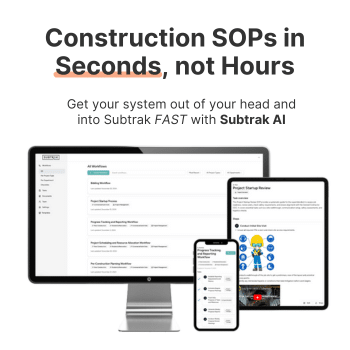
👈 Use this SOP template inside Subtrak
Edit with AI. Customize in seconds. Store and share all your SOPs and checklists in one place.