
Pre-Drywall Inspection Checklist for Home Builder
The Pre-Drywall Inspection Checklist is a critical quality control process for home builders specializing in custom homes. This checklist ensures that all structural and mechanical systems are correctly installed and meet code requirements before drywall installation. The inspection covers framing, mechanical, electrical, plumbing, insulation blocking, fire stopping, moisture barriers, and penetrations. Completing this checklist helps prevent costly rework, ensures safety and compliance, and maintains the quality standards expected in custom home construction.
Inspect framing for structural integrity
Step 1: Verify wall stud alignment
Use a laser level or plumb bob to check that wall studs are straight and properly aligned. Ensure that studs are spaced according to the design specifications, typically 16 or 24 inches on center.
Step 2: Check for proper nailing and fastening
Inspect all nailing and fastening points to ensure they meet code requirements. Use a hammer or nail gun to secure any loose nails or fasteners.
Step 3: Examine headers and beams
Ensure that all headers and beams are correctly sized and installed. Check for any signs of warping or damage and replace any compromised components.
Inspect mechanical systems installation
Step 1: Check ductwork installation
Verify that all ductwork is properly sealed and insulated. Ensure that ducts are securely fastened and supported according to code.
Step 2: Inspect HVAC equipment placement
Ensure that HVAC units are installed in the correct locations and are accessible for maintenance. Check for proper clearance around equipment.
Step 3: Verify vent and register placement
Ensure that all vents and registers are installed in the correct locations as per the design plan. Check for any obstructions that may impede airflow.
Inspect electrical systems installation
Step 1: Verify wiring installation
Check that all wiring is properly routed and secured. Ensure that wires are not pinched or damaged and that they are protected by conduit where required.
Step 2: Inspect outlet and switch placement
Ensure that all outlets and switches are installed at the correct height and location. Check that they are securely fastened and properly wired.
Step 3: Check electrical panel installation
Verify that the electrical panel is installed in an accessible location and is properly labeled. Ensure that all circuits are correctly wired and breakers are installed.
Inspect plumbing systems installation
Step 1: Verify pipe installation
Check that all pipes are properly secured and supported. Ensure that there are no leaks and that pipes are insulated where required.
Step 2: Inspect fixture placement
Ensure that all plumbing fixtures are installed in the correct locations and are securely fastened. Check for proper alignment and operation.
Step 3: Check drainage system installation
Verify that all drainage systems are properly sloped and free of obstructions. Ensure that vent pipes are installed correctly to prevent sewer gas entry.
Inspect insulation blocking and fire stopping
Step 1: Check insulation installation
Ensure that insulation is installed in all exterior walls, ceilings, and floors as per the design specifications. Check for gaps or compression that could reduce effectiveness.
Step 2: Verify fire stopping installation
Inspect all penetrations and openings for proper fire stopping materials. Ensure that fire-rated caulk or other approved materials are used to seal gaps.
Step 3: Inspect blocking for fixtures
Ensure that blocking is installed where needed for fixtures and cabinets. Check that blocking is securely fastened and properly aligned.
Inspect moisture barriers and penetrations
Step 1: Verify moisture barrier installation
Ensure that moisture barriers are installed on all exterior walls and roofs. Check for proper overlap and sealing at seams and edges.
Step 2: Inspect penetration sealing
Check that all penetrations, such as pipes and vents, are properly sealed with approved materials to prevent water intrusion.
Step 3: Check flashing installation
Verify that flashing is installed around windows, doors, and other openings. Ensure that flashing is properly integrated with moisture barriers.
Document inspection findings
Step 1: Record inspection results
Use a digital or paper checklist to record the results of each inspection task. Note any deficiencies or areas that require correction.
Step 2: Communicate findings to project team
Share the inspection results with the project manager and relevant trades. Ensure that any required corrections are clearly communicated and understood.
Step 3: Update project documentation
Ensure that all inspection records are filed and stored according to company procedures. Update any project documentation to reflect the current status of the inspection.
Ensure deficiencies are corrected
Step 1: Identify responsible trades
Determine which trades are responsible for correcting each deficiency. Use the project schedule and contact list to coordinate with the appropriate teams.
Step 2: Schedule corrective actions
Work with the project manager to schedule time for corrective actions. Ensure that all necessary materials and personnel are available to complete the work.
Step 3: Verify completion of corrections
Conduct a follow-up inspection to verify that all deficiencies have been corrected. Ensure that corrections meet quality standards and code requirements.
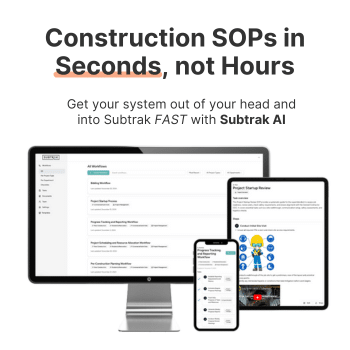
👈 Use this SOP template inside Subtrak
Edit with AI. Customize in seconds. Store and share all your SOPs and checklists in one place.