

Related Posts

Most construction companies run on tribal knowledge. The leadership team knows how jobs should run. A few key employees understand the details. Everyone else learns by shadowing, asking questions, and figuring things out as they go.
That approach works for small teams, but it breaks down as companies grow. When processes only exist in people’s heads, mistakes happen, training takes longer, and the owner becomes the bottleneck for decisions.
A construction SOP playbook solves this problem by capturing how your company actually operates. Instead of relying on memory, your team can follow clear processes and standard operating procedures that are documented, organized, and accessible.
The key is building a playbook that your team will actually use.
What Is a Construction SOP Playbook?
A construction SOP playbook is a centralized system that documents how your company performs its work. It organizes operational knowledge into repeatable processes and clear instructions.
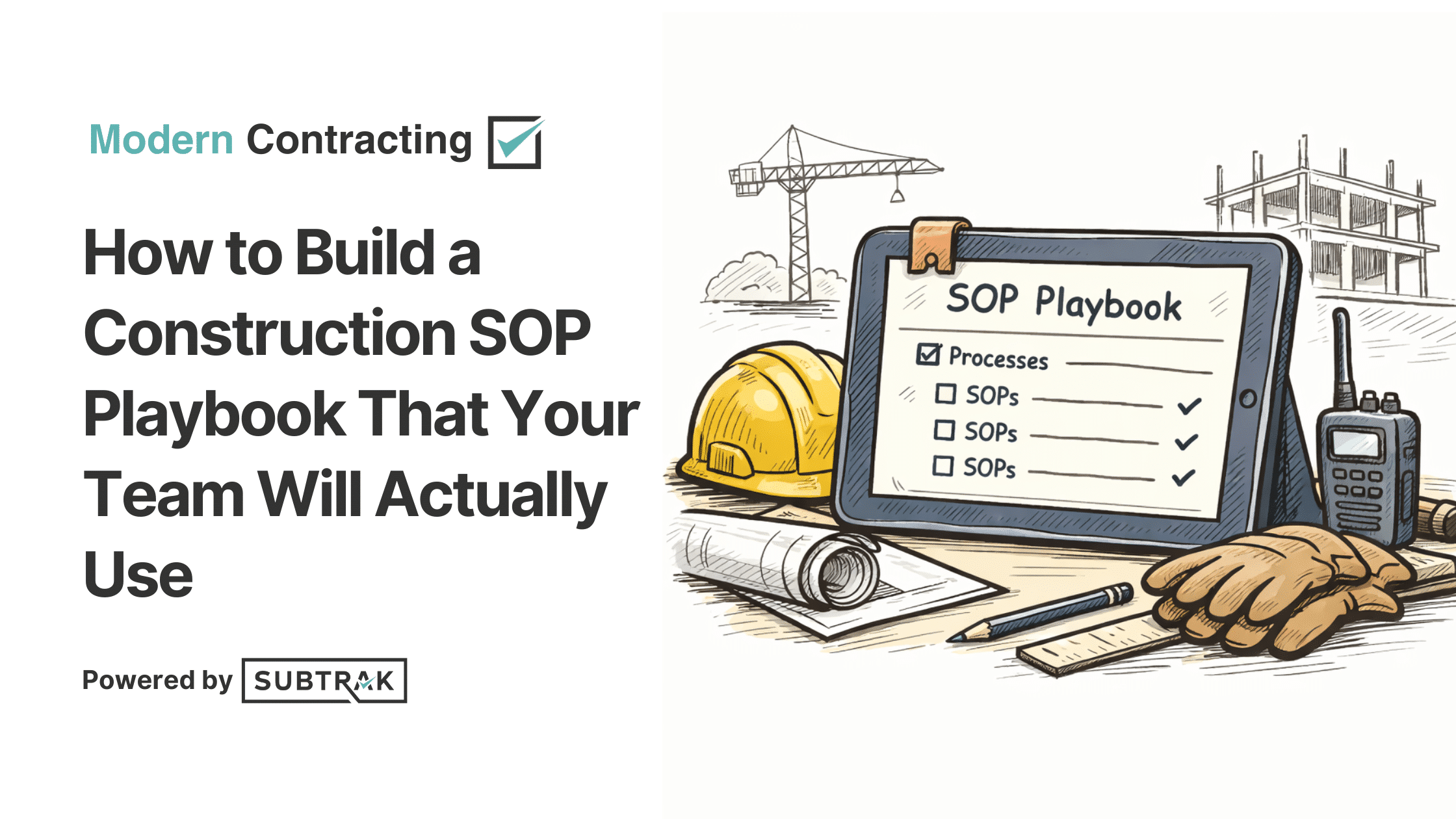
Playbooks in Subtrak follow a simple hierarchy:
Playbook → Processes → SOPs
-
Playbook: The complete system that documents how your company operates
-
Process: A workflow made up of multiple SOPs
-
SOP (Standard Operating Procedure): Detailed instructions for performing a specific task
For example:
Process: Project Startup
Possible SOPs inside that process:
-
Create the job in your project management software
-
Schedule the pre-construction meeting
-
Order job signage
-
Submit permit documentation
-
Notify accounting to set up job cost codes
Processes describe the overall workflow, while SOPs explain how to perform each step within that process correctly.
This structure helps employees understand not only what their tasks are, but also how their work connects to the rest of the company.
Start With Core Processes, Not Everything
The most common mistake companies make is trying to document everything at once.
A great construction playbook starts with the processes that matter most. These are the workflows that are repeated frequently and have the biggest impact on profitability, quality, and consistency.
Examples of core construction processes include:
-
Sales process
-
Estimating process
-
Project startup
-
Change order management
-
Safety inspections
-
Project closeout
-
Warranty handling
These processes often involve multiple roles and many steps. When they are undocumented, mistakes and inconsistencies are almost guaranteed.
A small set of well documented core processes is far more valuable than hundreds of scattered notes.
Focus on documenting the workflows that cost you time, create confusion, or affect customer outcomes.
Organize Your Playbook by Department and Project Type
A construction SOP playbook should mirror how your company actually operates.
Most contractors naturally organize their documentation by department. This makes the playbook intuitive to navigate and easier for employees to find what they need.
Common departments include:
-
Sales
-
Estimating
-
Preconstruction
-
Field Operations
- Project Management
-
Safety
-
Accounting
-
Human Resources
Within each department, processes may also vary based on project type.
For example, a roofing company may document separate processes for:
-
Residential reroof projects
-
Commercial reroof projects
-
Service repairs
A home builder might document processes for:
-
Custom home construction
-
Spec home construction
-
Property management services
Organizing documentation this way ensures that employees see the processes that are relevant to the work they perform.
Assign SOPs to Roles, Not Individuals
Construction companies experience constant staffing changes. Employees move on, new hires join, and responsibilities shift over time.
For this reason, SOPs should always be assigned to roles rather than specific people.
Examples of common roles include:
-
Estimator
-
Project manager
-
Superintendent
-
Safety manager
-
Office administrator
Assigning SOPs to roles creates several benefits.
First, new employees can immediately understand their responsibilities when they step into a position.
Second, documentation remains relevant even when staff changes occur.
Third, accountability becomes clearer because each role has defined tasks within the company’s processes.
A playbook built around roles becomes a training system for the entire company.
Use Processes to Show How Work Connects
Construction projects rely on coordination between multiple roles in different departments. When employees only understand their own tasks, handoffs between departments often break down.
Documented processes help teams understand how their work fits into the larger workflow.
Consider a project startup process. It may involve:
-
Sales handing off the signed contract
-
Estimating providing job specifications
-
Project managers scheduling the kickoff meeting
-
Accounting setting up job cost codes
-
Field superintendents preparing the job site
Each step depends on the previous one being completed correctly and efficiently.
When the entire process is documented, employees can see:
-
What must happen before their task
-
What they are responsible for completing
-
What the next role depends on from them
This visibility reduces delays, missed steps, and communication breakdowns.
Make Your Playbook Accessible in the Office and in the Field
Construction work happens in many environments. Employees may need information while they are in the office, on a job site, or even in their truck between locations.
For documentation to be useful, it must be easy to access anywhere.
Effective playbooks are:
-
Mobile friendly
-
Searchable
-
Organized logically
-
Easy to update as processes evolve
When documentation is difficult to find or buried in long manuals, teams rarely use it.
That’s why Subtrak includes features such as searchable SOP libraries, shareable links, and QR codes that allow field teams to access instructions directly from the job site.
Accessibility is one of the biggest factors that determines whether documentation actually improves operations.
Focus on Clarity Over Perfection
Many companies delay documentation because they feel everything needs to be fully written out before it is useful.
In reality, even a partially documented process can dramatically reduce confusion.
Start by defining the process itself. List the key SOPs that make up the process and assign each one to the appropriate role in your company. Even if the detailed instructions are not written yet, this structure immediately clarifies who is responsible for what.
For example, a project startup process might include SOPs such as:
-
Create the job in project management software
-
Schedule the pre-construction meeting
-
Order job signage
-
Submit permit documentation
-
Set up job cost codes
When these steps are clearly defined and assigned to roles like estimator, project manager, or office administrator, new employees can quickly understand their responsibilities within the larger process.
Detailed instructions can always be added later. The most important step is defining the process and making responsibilities clear.
Over time, your team can refine and expand each SOP as your documentation improves.
How Subtrak Helps Contractors Build SOP Playbooks
Subtrak is designed specifically to help contractors build organized and accessible construction playbooks.
Instead of storing documentation in scattered documents or spreadsheets, Subtrak helps construction companies to structure their knowledge into playbooks, processes, and SOPs.
Contractors use Subtrak to:
-
Organize documentation by department and workflow
-
Assign SOPs to roles within the company
-
Structure tasks within repeatable processes
-
Access documentation from the office or the field
-
Share processes through links or QR codes
By capturing tribal knowledge and organizing it into a searchable system, companies can ensure their standards are consistently followed.
Build Systems That Scale With Your Company
The best construction companies do not rely on memory alone. They rely on systems that help their teams operate consistently.
A well structured construction SOP playbook helps companies:
-
Train employees faster
-
Reduce costly mistakes
-
Standardize workflows
-
Capture institutional knowledge
-
Scale operations without chaos
The goal is simple: make it easy for your team to understand how work gets done in your company.
When your processes are documented and accessible, your business no longer depends on a few key individuals. Instead, your entire team can operate from the same playbook.